What is Electronic stamp ?
Electronic stamp: This new service has been introduced as part of the state’s efforts to enhance the security of e-government transactions. It has the potential to become an alternative to the “Eagle Seal” in the future.
Its primary objective is to establish a centralized, documented, and secure archive of official electronic transactions. Additionally, it aims to bolster ministries’ capabilities in managing real-time crises and strategically disseminating information and government decisions in a highly secure electronic manner.
What is the Electronic stamp?
The e-seal in ksa is a functions as an electronic and encrypted authentication stamp on digital information such as emails, macros, or electronic documents. Its purpose is to verify that the information was issued by the signatory and has remained unaltered.
Also is instrumental in digitizing and streamlining administrative procedures. By ensuring the security of administrative documents like wage cards and invoices, it facilitates the safe storage of electronic documents.
The difference between a seal and an electronic signature
Organizations are transitioning from paper-based processes to more efficient models, with e-signature and e-seal forms replacing traditional ones.
The primary distinction between a seal and an e-signature lies in their functions. An e-signature represents a person’s handwritten, phonetic, or code signature in electronic form. In contrast, a seal is a secure electronic signature utilizing encryption technology, ensuring tamper resistance, non-repudiation, and data integrity.
The electronic seal is linked to the company’s registration number and is utilized in two scenarios: self-registration and when an ERP system is present at the financier. Conversely, the electronic signature is linked to the authorizer’s national number and is used only when accessing a portal. Hence, it’s unsuitable for self-registration.
The electronic seal is employed in all instances: registration, presence of ERP, and portal usage. Regarding specifics:
- Electronic Signature: also known as Digital Signature is exclusively used on the Tax Authority’s portal for issuing invoices during the trial period, requiring only the commissioner’s national number for registration..
- Electronic Seal: referred to as Seal Certificate, is used in two scenarios: issuing invoices from the Tax Authority’s portal or through an ERP system linked to the Tax Authority. It necessitates a tax registration number for issuance.
For further details, refer our frequently asked questions.
Why Tax2gov?
Tax2gov is who which provides comprehensive software integration and compliance with the electronic invoicing requirements specific to the “Fatoora” platform designated by the Saudi Authority for Zakat, Tax, and Customs.
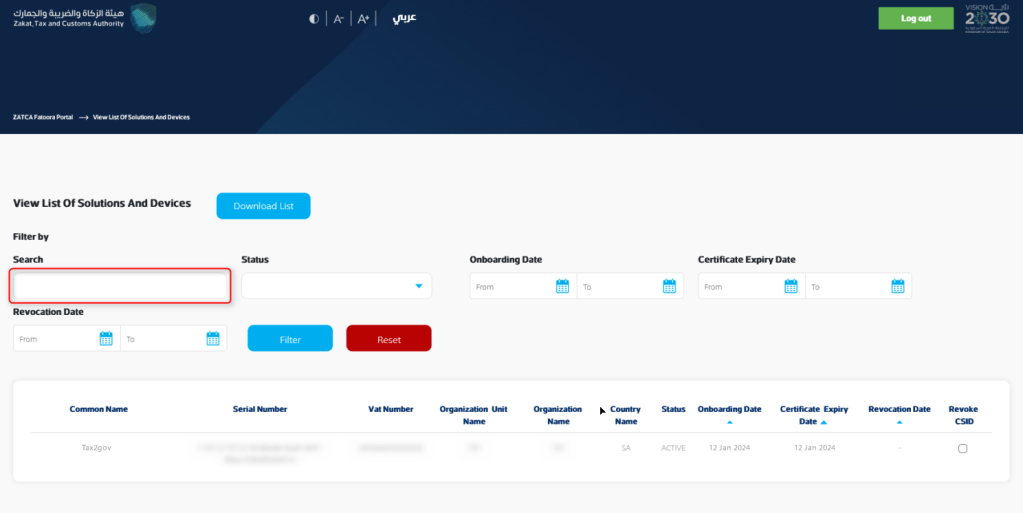
The user can review their devices (along with all their detailed information) associated with the Fatoora platform. Additionally, the user can also search for associated devices through the search box, as illustrated in the attached image.